What Happens If My Business Gets Hit with Ransomware?
What Happens If My Business Gets Hit with Ransomware? Southern Indiana Business and Cybersecurity
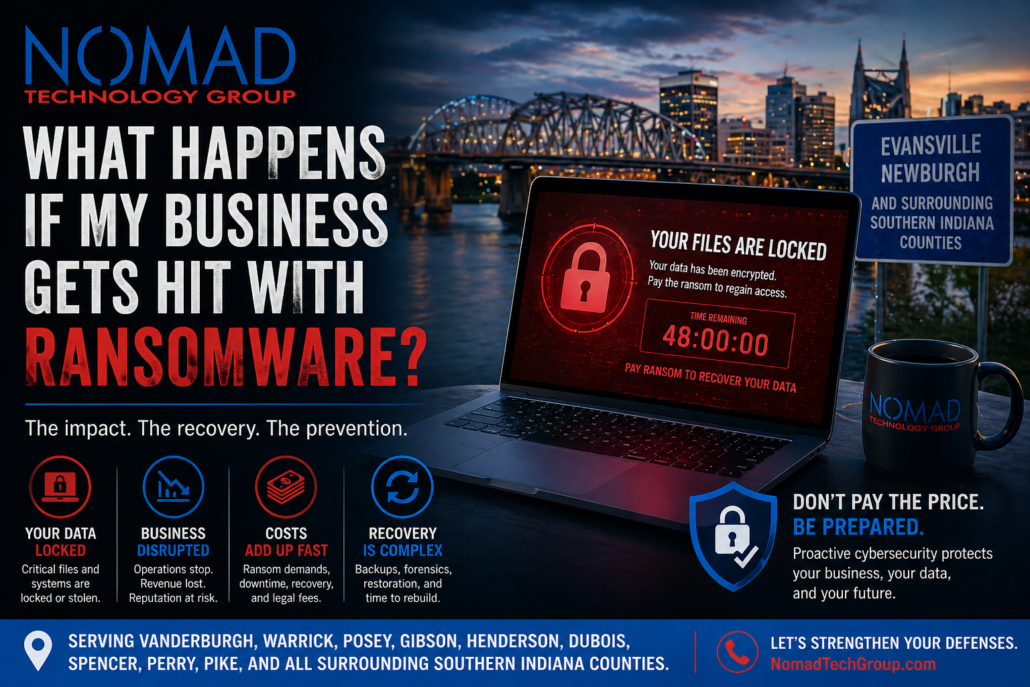
What Happens If My Business Gets Hit with Ransomware?
Ransomware attacks are no longer rare events that only affect large corporations. Businesses throughout Southern Indiana, including Evansville, Newburgh, Henderson, Jasper, Princeton, Boonville, Mount Vernon, and surrounding counties, are increasingly becoming targets.
For many small and mid-sized businesses, ransomware can bring operations to a complete halt within minutes.
If your business suddenly loses access to critical files, customer data, or internal systems, ransomware may be the cause.
Understanding what happens during a ransomware attack can help you prepare, respond faster, and reduce damage if your business is ever targeted.
What Is Ransomware?
Ransomware is a type of malicious software that encrypts your business data and locks you out of systems until a payment demand is met.
Cybercriminals often demand payment in cryptocurrency in exchange for a decryption key.
Once ransomware enters a network, it can spread quickly across:
- Computers and laptops
- Shared business drives
- Cloud storage systems
- Servers and databases
- Backup files connected to the network
Ransomware attacks are designed to create panic, pressure businesses into paying quickly, and maximize downtime.
How Ransomware Usually Starts
Many business owners assume ransomware comes from highly sophisticated hacking.
In reality, most ransomware infections begin with simple human error.
Common entry points include:
- Clicking on a phishing email link
- Opening a malicious email attachment
- Weak or stolen passwords
- Unsecured remote desktop access
- Outdated software vulnerabilities
- Compromised vendor or third-party accounts
For businesses in Evansville, Newburgh, and surrounding Southern Indiana communities, ransomware often begins with a single employee accidentally clicking a harmful email.
What Happens Immediately After a Ransomware Attack?
Ransomware attacks often unfold quickly.
Many businesses do not realize an attack is happening until systems are already encrypted.
Here is what typically occurs after ransomware infects your network.
1. Files Become Locked or Inaccessible
Employees may suddenly lose access to:
- Shared folders
- Accounting systems
- Customer records
- Email systems
- File servers
- Operational software
Documents may display unusual file extensions or refuse to open.
2. A Ransom Note Appears
Attackers usually leave a message demanding payment.
The ransom note often includes:
- A payment deadline
- Cryptocurrency instructions
- Threats to delete or leak data
- Contact information for negotiations
Some attackers now threaten to publicly release sensitive business information if payment is not made.
3. Business Operations Slow or Stop
For many businesses, ransomware means immediate downtime.
This can affect:
- Scheduling systems
- Inventory management
- Manufacturing processes
- Customer service
- Billing and invoicing
- Payroll and financial systems
Even a short outage can create major financial losses.
4. Data May Be Stolen Before Encryption
Modern ransomware attacks often involve data theft before encryption begins.
This tactic, known as double extortion, allows attackers to demand payment twice:
- Once to unlock data
- Again to prevent stolen data from being leaked
Sensitive information may include:
- Customer records
- Financial information
- Employee data
- Healthcare records
- Vendor contracts
- Login credentials
How Ransomware Impacts Businesses in Southern Indiana
Businesses throughout Vanderburgh County, Warrick County, Gibson County, Posey County, Pike County, Spencer County, and Dubois County face increasing ransomware risks.
Local businesses often assume cybercriminals only target major cities.
However, attackers frequently focus on regional organizations because they may have:
- Smaller IT teams
- Limited cybersecurity budgets
- Older technology infrastructure
- Fewer monitoring tools
- Less cybersecurity training
Industries commonly targeted in Southern Indiana include:
- Healthcare practices
- Manufacturing companies
- Construction firms
- Retail businesses
- Law firms
- Accounting offices
- Schools and nonprofits
Ransomware does not discriminate based on company size.
Should You Pay the Ransom?
This is one of the most difficult decisions businesses face during an attack.
Cybersecurity professionals generally advise against paying ransomware demands.
Reasons include:
- Payment does not guarantee data recovery
- Attackers may demand more money later
- Stolen data may still be leaked
- Paying encourages future attacks
- You may become a repeat target
Some organizations recover without paying by restoring backups or rebuilding systems.
The best option depends on the severity of the attack and the strength of your recovery strategy.
What To Do If Your Business Gets Hit With Ransomware
If ransomware affects your business, taking the right steps quickly is critical.
1. Disconnect Infected Devices
Immediately isolate affected systems from the network.
This helps prevent ransomware from spreading to additional devices.
Disconnect:
- Computers
- Servers
- Wi-Fi access
- Shared drives
- Remote connections
2. Contact a Cybersecurity Professional
Do not attempt to handle ransomware alone.
Professional cybersecurity teams can:
- Identify the ransomware strain
- Determine the scope of the breach
- Preserve forensic evidence
- Assist with recovery
- Prevent reinfection
3. Avoid Deleting Files Immediately
Deleting encrypted files can make recovery more difficult.
Preserve evidence while security professionals investigate.
4. Notify Insurance and Legal Advisors
Cyber insurance policies may require specific reporting procedures.
Legal advisors can also help determine notification requirements if sensitive customer data was exposed.
5. Restore from Secure Backups
If backups are available and unaffected, businesses may recover without paying attackers.
This highlights why secure backup systems are critical.
How to Prevent Ransomware Attacks
Preventing ransomware requires layered cybersecurity.
Businesses in Evansville, Newburgh, and Southern Indiana can reduce risk by implementing:
- Multi-factor authentication (MFA)
- Employee phishing awareness training
- Regular software updates and patching
- Endpoint protection software
- Secure data backups
- Email filtering and spam protection
- Network monitoring
- Limited user permissions
Proactive cybersecurity significantly lowers the likelihood of a successful attack.
How Nomad Technology Group Helps Businesses Recover and Prevent Ransomware
At Nomad Technology Group, we help businesses throughout Southern Indiana strengthen their defenses against ransomware.
Our services include:
- Managed cybersecurity monitoring
- Threat detection and incident response
- Vulnerability assessments
- Backup and disaster recovery planning
- Employee cybersecurity training
- Endpoint security and network protection
- Firewall management
- Ransomware recovery support
We help local businesses prepare before attacks happen and respond quickly when incidents occur.
Ransomware Starts With Preparation Recovery
The businesses that recover fastest from ransomware are usually the ones that prepared in advance.
A proactive cybersecurity plan can reduce downtime, limit financial damage, and improve recovery outcomes.
If your business operates in Evansville, Newburgh, or anywhere in Southern Indiana, now is the time to strengthen your cybersecurity defenses.
Protect Your Southern Indiana Business From Ransomware
Ransomware attacks can impact businesses of any size.
The good news is that many attacks are preventable with the right cybersecurity strategy.
Nomad Technology Group helps businesses throughout Southern Indiana identify vulnerabilities, strengthen protection, and reduce ransomware risk.
Do not wait until ransomware shuts down your operations. Protect your business before an attack occurs. Never have to worry about What Happens If My Business Gets Hit with Ransomware again.

